Posts

A timeline of thoughts, updates, and micro-reflections shared across the web.

  • If your headline is vague, you’re asking a stranger to trust you with no reason.

    Your LinkedIn headline is not a title. It’s a filter.

    If I can’t explain what I do in one breath, I’m not clear enough yet.

    I’m not trying to attract everyone. I’m trying to repel the wrong buyer.

    If it doesn’t tell the right person what you do in a sentence, you’re forcing them to work. They won’t.

    The 5-second game

    Show your profile to someone smart. Give them 5 seconds. Ask:

    “Who is this for?”

    If they answer with your job title, it failed.

    If they can’t answer in 5 seconds, it’s not a headline. It’s a slogan.

    A clean pattern (because it forces clarity)

    I help [target] get [outcome] with [mechanism].

    I use it because it makes me pick a lane.

    A quick example

    Before: “Helping businesses grow..”

    After: “I help founders say what they actually think—clearly—so buyers get it.”

    Same person. Now it’s legible.

    One edit rule

    Replace your job title with a verb. If you can’t, you’re not clear yet.

    Your headline is the promise of relevance.

    If it’s vague, it’s noise.

  • If your best work is under NDA, you’ve got a problem.

    You can’t screenshot the dashboard. You can’t name the client. You can’t post the numbers.

    So you end up saying nothing. Or you say vague things like “great results.”

    Here’s a better rule: Don’t try to prove the result. Show how you work.

    Not with big claims. With things that are hard to fake.

    What to share instead of numbers

    1. The calls you make What do you do when the obvious move is tempting but wrong? Example: “We stopped doing X because it made the posts noisier, not clearer.”

    2. The shift you made Not metrics. The change in approach. Example: “Before: ‘post whenever.’ After: ‘we only publish when the point passes a filter.’”

    3. Your ‘won’t do’ list The lines you won’t cross. Example: “If it sounds impressive but empty, it dies.”

    4. The stuff you actually use A checklist. A workflow. A quick QA gate. Anything a client could point to and say: “This is how they run it.”

    5. How you handled the constraints The best proof is often: “we did this properly, under pressure, without cutting corners.”

    A quick example

    Before: “We helped them grow.”

    After: “We turned their publishing from last-minute scrambling into a simple weekly routine.”

    Same idea. Now it means something.

    What your buyer is actually trying to learn

    They’re not asking for your numbers. They’re trying to work out:

    Can you explain what you do in plain English?

    Do you have a bar?

    Will you make the right calls when nobody can see the work?

    Numbers are nice, but people pay for the work behind them.

  • When people say ghostwriting feels fake, they usually mean one of two things:

    “Someone helped me write.”

    “Someone put words in my mouth.”

    Only the second one is a problem.

    Here’s the clean way to see it.

    There are levels of help

    Editing You wrote it. Someone improves the writing.

    Shaping You provided the raw material. Someone turns it into a clean post.

    Drafting You provided the thinking. Someone writes the first draft. You edit and approve.

    Inventing You didn’t provide the thinking. The writer creates opinions, stories, or claims you wouldn’t stand behind.

    That last one is deception.

    Deception isn’t “getting help.” Deception is publishing thinking you didn’t do.

    Two questions settle the ethics

    Did you supply the thinking?

    Did you approve the claims?

    If the answer is “no”… don’t publish it.

    My ship/no-ship gate

    If any of these fail, it doesn’t ship.

    If you can’t explain the post in your own words, it doesn’t ship.

    If you wouldn’t defend it in a room, it doesn’t ship.

    If it sounds impressive but empty, it doesn’t ship.

    If it reads like advertising, it doesn’t ship.

    A quick example

    Before: “I’ve been thinking a lot about leadership lately.”

    After: “Here’s the decision I made this week — and the cost I accepted.”

    Same point. Now it’s real.

    Voice-true ghostwriting looks like:

    you provide raw material (voice notes, bullets, beliefs, decisions)

    someone turns it into readable writing

    you challenge it, edit it, approve it (or reject it)

    That’s not “fake.” That’s treating writing like a craft.

  • Most LinkedIn posts fail a simple test.

    Remove the author name.

    If the post still works, you have a voice. If it becomes generic, you were leaning on tone.

    My 3-word gate

    Mine are:

    Clear. Coherent. Collected.

    Not because they sound nice.

    Because they’re part of who I am. I don’t do well with chaos or vague language. I need the world to make sense.

    How I use it

    I score the draft line-by-line.

    Clear: is the point obvious, or does the reader have to guess?

    Coherent: does the logic actually hold together, or does it contradict itself?

    Collected: is it grounded and steady, or is it performing confidence?

    If it’s 1/3, it’s not ready.

    A quick example

    If I see a line like:

    “Excited to share some thoughts…”

    I treat it as a leak.

    Rewrite it into something I’d actually defend:

    “I’m not interested in ‘personal branding.’ I’m interested in earning trust. So I’m building a system that forces clarity before it ships.”

    Same topic. Different spine.

    If you want your writing to compound, it needs fingerprints. Not polish.

  • I hate advertising.

    If it were a person, it would be that guy at the party who cuts in mid-sentence.

    • Interrupts your conversation.
    • Presses on your weak spots.
    • And then smiles like he’s helping.

    I know that sounds intense, but I genuinely can’t stand it.

    To me, advertising is manipulation wearing a friendly face.

    I pay for premium subscriptions to avoid it.

    I won’t install mobile apps if they’re packed with ads.

    I’ve been using an ad blocker since 1999. (Yes, I’m old)

    The irony is my background is in marketing and advertising.

    I’ve run ad campaigns.

    And the annoying truth is, they work.

    • Not by informing you.
    • By bypassing judgement.
    • By exploiting attention.

    Once you’ve seen the mechanism, you can’t unsee it.

    And here’s the awkward part.

    I know exactly why they convert.

    They don’t appeal to the rational bits.

    They press on the human ones.

    • Fear.
    • Insecurity.
    • Impulse.

    And once you see that…

    It’s hard to pretend it’s just “marketing”.

  • I wrote a post this morning.

    It was clean. It was smart. It was safe.

    And I deleted it.

    Not because it was bad. Because it didn’t feel like anything.

    Truth is, I still get that little jolt in my chest before I hit “Post”. Like I’m stepping out where people can see me.

    Years ago I avoided all of this. Life was quieter. I was fine with that.

    But rebuilding costs you some comfort if you want momentum.

    So I rewrote it.

    Not to sound better. To sound like me.

    That’s the part people skip when they talk about “consistency”.

    The hard part isn’t writing.

    It’s letting the real version of you be seen.

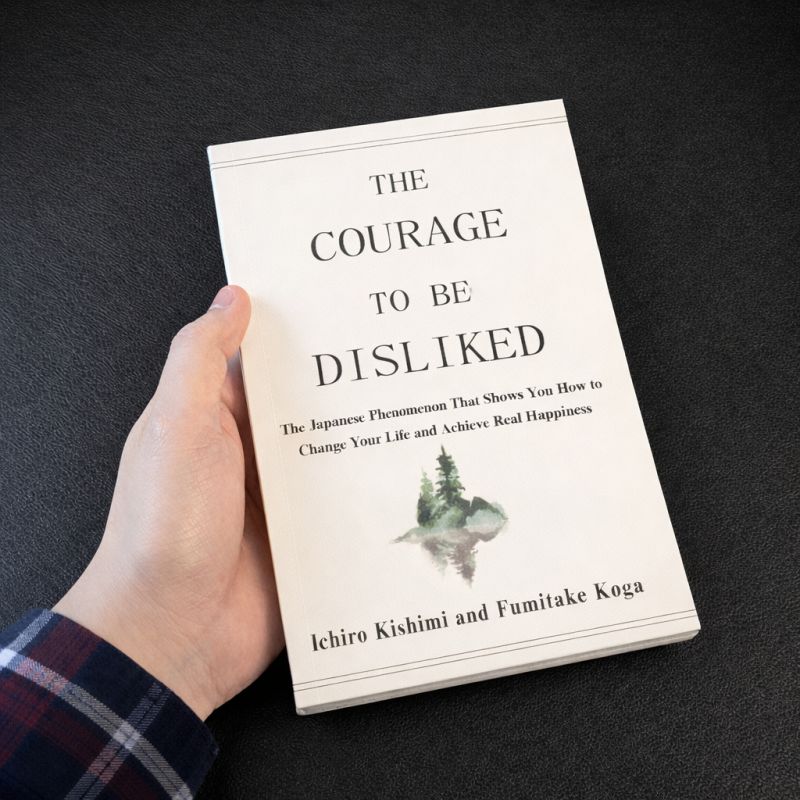
    Felt like the right book today.

  • Consistency isn’t a motivation problem.

    It’s an idea supply problem. Some people struggle to come up with ideas while others have way too many.

    I’m the latter.

    Still, both are a problem. I built a solution.

    And no, I’m not talking about a “content calendar.”

    I’m talking about a framework that helps you generate ideas and filter them down using your own rules.

    A content ideation engine with built‑in guardrails.

    It forces every idea through 5 filters:

    • Objective
    • Target
    • Positioning
    • Signals
    • Pillars

    So instead of chasing more ideas, or staring at a list of “maybe” posts. I can filter hundreds down to the few that actually matter.

    I’ll share more later. For now, I’m using it.

    If you see me posting more often, this is why.

    What do you use to decide which ideas make the cut?

  • I’ve been quiet for a reason.

    I’ve been building a framework that helps me generate hundreds of ideas on demand without drifting into noise.

    I’ve designed this framework to keep every idea aligned with my goals (not random inspiration, not trends).

    I’m not going to share the whole thing yet.

    But the concept behind it all is simple:

    Every post has to earn its place.

    If it doesn’t support my goals, it doesn’t get written.

    Here’s my next step:

    I’m putting it to the test, which means you’ll start seeing content more regularly from here.

    Not louder. Just more consistent.

    Where do you get stuck most: ideas or execution?

  • I opened LinkedIn earlier today to do a quick engagement sweep. Coffee in hand. Two minutes in, I noticed a pattern.

    People aren’t struggling to post. They’re struggling to sound like themselves.

    That caught my attention because I’m building a content strategy framework for my own use. I started with templates and a calendar… and it felt hollow.

    Here’s the uncomfortable part.

    If you skip voice, you can still get authority. But it’s the interchangeable kind. The kind where you can swap the name at the top and nothing changes.

    And I’m not saying that as a critique. It’s just what happens when you optimise for consistency before you lock in signal.

    A few scrolls later, the mistake is usually the same.

    People start with topics and templates. They fill the slots. They hit publish.

    It reads fine… but it doesn’t sound like a person. Not because they’re “bad”. But because it doesn’t feel unique to the author.

    Voice is the one asset that doesn’t get commoditised. Once your voice is clear, everything else becomes a tool. Templates help. Calendars help. AI helps.

    The hard part is judgement. What’s yours. What’s noise. What’s borrowed.

    And capturing voice in writing is about noticing patterns:

    • Your cadence (how you naturally speak)
    • Your default beliefs (what you assume is true)
    • Your repeating phrases (what you say without thinking)

    Skip this step and you’ll still get content. You might even get good content. You might get engagement. You might even go viral.

    But you won’t get trust if it doesn’t sound like you when you speak.

    Capture the voice first and everything downstream gets easier. The content becomes consistent. It feels human. And speed becomes the byproduct.

    If your content feels like it isn’t you right now, ask yourself:

    Are you trying to fill a slot? Or are you trying to share what you think?

  • I’m building a system right now.

    AI makes me faster, but speed isn’t the hard part.

    The hard part is the human part:

    • What to put in? What to leave out?
    • What to say? What not to say?
    • What’s actually me? What isn’t?

    AI could generate 100 posts in 15 minutes. None of them would make people trust me.

    Because trust isn’t output. It’s judgement.

    AI could draft a post, but:

    • It can’t grow your skills.
    • It can’t develop your taste.
    • It can’t make the hard calls.

    So I’m building an AI system with a human spine.

    Follow me and watch me build.

  • About two months ago, I wrote:

    “I’m rebuilding my life, and this is the next step.”

    That wasn’t a motivational line. It was a decision.

    If people can’t see you, they can’t trust you.

    So that’s what 2026 is about for me:

    Content is strategy.

    It’s how you build trust without begging for it. It’s how you show the truth of what you know. It’s how you turn competence into authority.

    This is the road I’m walking in 2026.

    If you’re also rebuilding something this year, I’m with you.

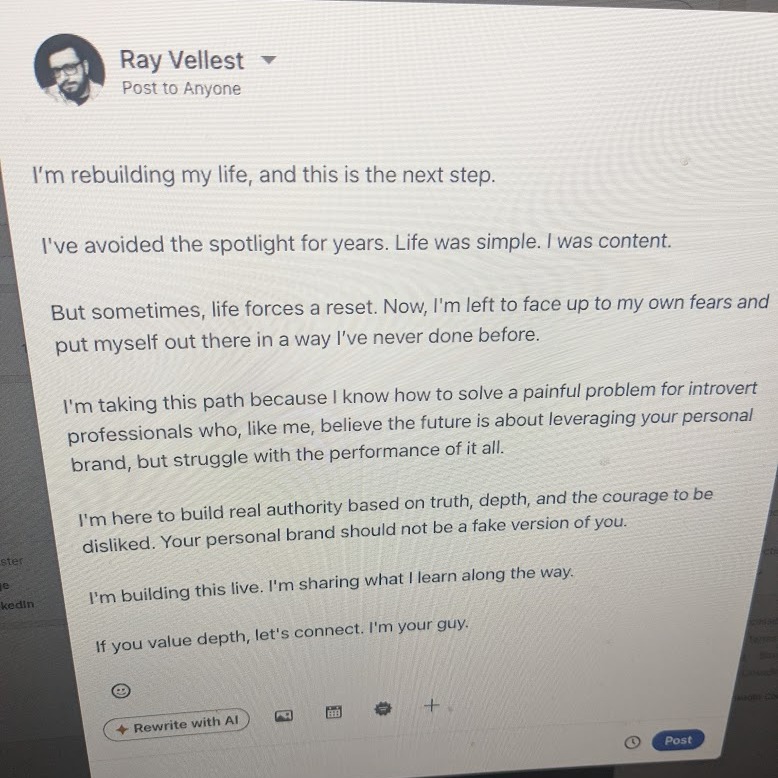
  • I’m rebuilding my life, and this is the next step.

    I’ve avoided the spotlight for years. Life was simple. I was content.

    But sometimes, life forces a reset. Now, I’m left to face up to my own fears and put myself out there in a way I’ve never done before.

    I chose this path because I know how to solve a painful and expensive problem for introvert professionals who, like me, believe the future is about leveraging your personal brand, but struggle with the performance of it all.

    My commitment is to build real authority based on truth, depth, and the courage to be disliked. Your personal brand should not be a fake version of you.

    I’m building this live. I’ll share what I learn along the way.

    If you value depth, let’s connect. I’m your guy.